

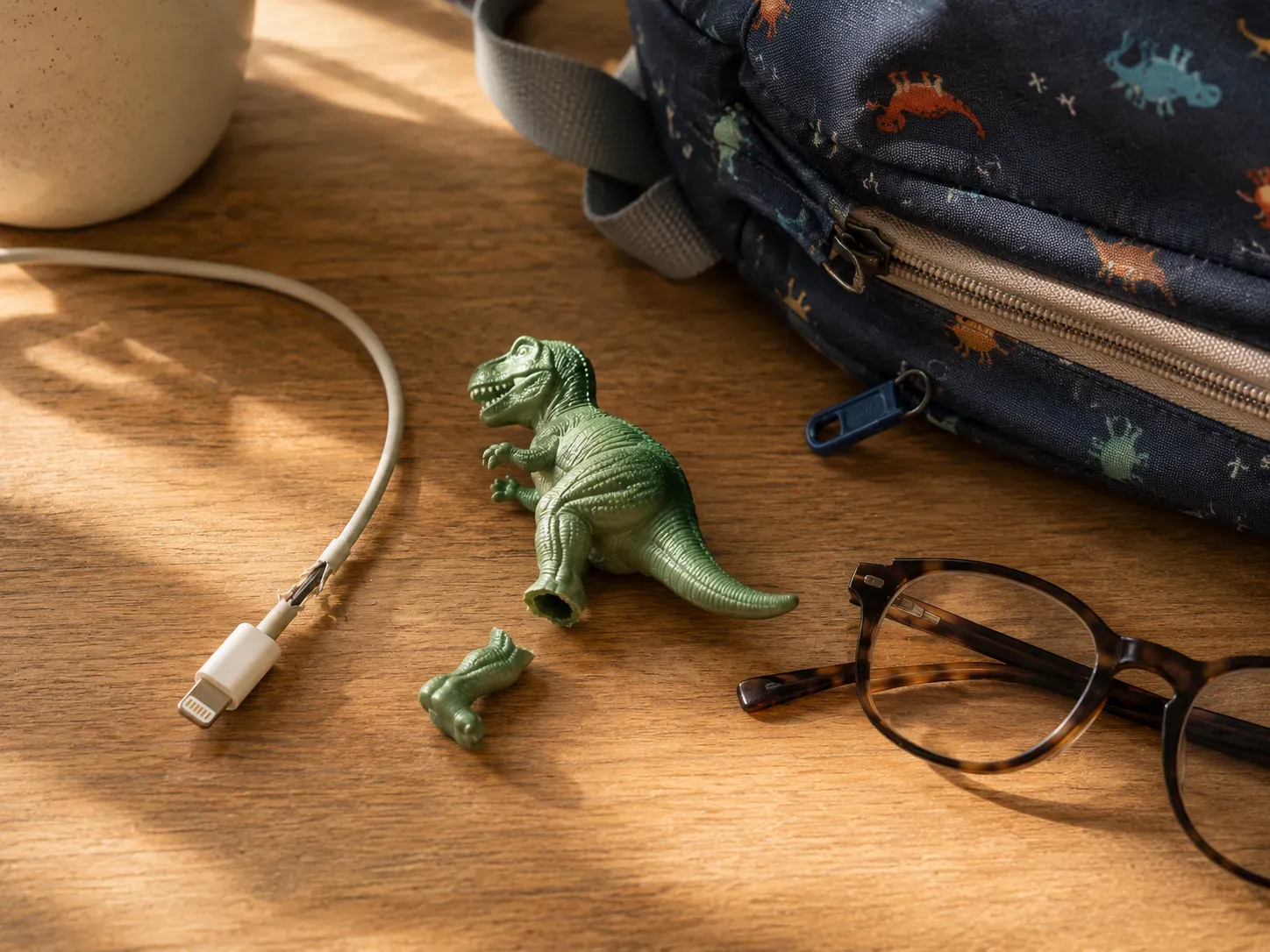
My kids’ tablet charger had been splitting at the connector for weeks.
A plastic leg snapped off my son’s favorite dinosaur at 7 AM on a school morning.
And the last time I reached for superglue, I ended up with my fingers bonded together for twenty minutes.
That was the moment I genuinely said out loud, to no one in particular: there has to be a better way.
I don’t think of myself as someone who throws things away. I was raised by a mother who fixed everything — sewed buttons back on, glued handles back onto mugs, kept appliances running years past their expected lifespan. But somewhere along the way, I started doing the calculation in my head: the mess, the fumes, the failure rate, the wasted glue, the thing that ends up looking worse after you’ve “fixed” it. And I’d toss it. Another perfectly salvageable item in the trash, another quiet wave of guilt as the lid closed.
When my neighbor mentioned something she’d seen on a TV show — a repair stick that works like nothing else she’d tried — I was interested mostly out of desperation. I wasn’t hopeful. I was tired.
Why Superglue Has Always Been a Disaster Waiting to Happen
I’ve spent a lot of years thinking the problem was me — that I just wasn’t careful enough, wasn’t patient enough, didn’t read the instructions properly. But after years of glue disasters, I’ve come to believe the problem isn’t the user. It’s the product.
Four structural reasons why superglue fails most home repairs:
- It’s permanent — and completely unforgiving — position something even slightly wrong and you cannot undo it. No do-overs, no adjustments. Whatever you bonded is bonded forever, exactly like that.
- It hardens before you’re ready — the moment it contacts moisture (including humidity in the air), the clock starts ticking. By the time you’ve repositioned the pieces once, you’ve already lost your window. The repair looks worse than the original break.
- One use and it’s gone — open a tube, use a tiny fraction, and the cap seals shut within days. A $6 tube becomes a $6 single-use product. Half the time you reach for it again, it’s already dried solid in the drawer.
- The fumes are genuinely toxic — cyanoacrylate vapors cause eye irritation, respiratory irritation, and are especially problematic around children and pets. Every time I used it with my kids in the house, I was holding my breath — literally.
What FixIts Actually Is — And Why It’s Different
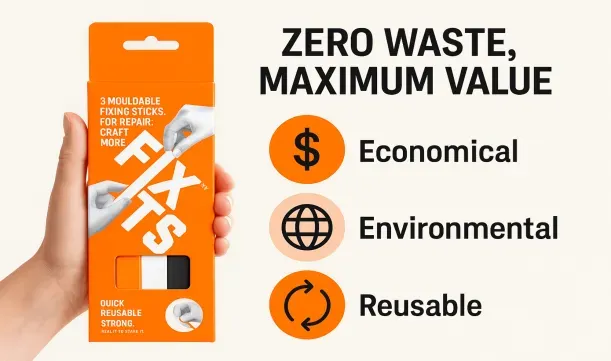
🔧 How FixIts works: FixIts is a thermoplastic repair stick — it softens when placed in hot water and becomes fully moldable within seconds, like a firm putty. Shape it around whatever needs fixing, hold it in place, and it hardens as it cools — reaching a holding strength of up to 16kg (35 lbs) in just 2–3 minutes. If you don’t like the result, drop it back in hot water and start over. No chemical fumes, no toxic compounds, no permanent mistakes. One pack of 3 sticks contains enough material for dozens of repairs, and there’s no shelf life — the sticks last forever. As seen on BBC One’s Dragons’ Den — Steven Bartlett called it an “Aha! product” and invested on the spot.
The thing that stopped me mid-scroll when I first read about it wasn’t the strength rating or even the no-fumes claim. It was one sentence: if you make a mistake, just reheat it and try again.
I had to read it twice.
In twenty years of DIY repairs, nothing had ever offered me that. Every other repair method operates on a one-shot model — you get it right or you live with the consequences. The reversibility of FixIts is, I think, the actual product. Everything else is almost secondary.
The First Time I Used It
The charging cable was my first test. The outer rubber casing had split at the base of the connector — a classic stress fracture that happens when kids pull on a cable at an angle a hundred times a day. Normally I’d either live with it (and watch it get worse) or order a replacement and feel the small sting of spending $20 on something that should have lasted longer.
I boiled the kettle. Dropped a piece of the FixIts stick into a mug of hot water for about thirty seconds. It went soft — actually soft, like warm modeling clay — and I pressed it around the split section, compressing it gently and smoothing the edges with my fingers.
It set in just over two minutes.
I tugged at it. Bent it at the same angle my kids always pull. It held. More to the point, it didn’t crack — the repair had some flex to it, which is exactly what a cable joint needs. Superglue would have shattered on the first bend.
The dinosaur was next. The snapped leg had a clean break, which turned out to be ideal — I softened a small piece, formed it around the joint, and held it in place while my son supervised with tremendous seriousness. By the time he’d finished his breakfast, the dinosaur was on the table, standing on all four legs, sturdy enough that he carried it to school that day.
I reheated and adjusted the dinosaur repair once — the first attempt had a small air gap I didn’t like. That took thirty seconds. With superglue, that would have been a permanent disaster. With FixIts, it was just the second draft.
How to Use FixIts — Four Steps
Drop a piece into hot water for 20–30 seconds
Hot tap water works fine; freshly boiled kettle water is faster. The stick turns slightly translucent as it softens — you’ll feel the change immediately. Break off only what you need for the repair; the rest stays firm, usable, and shelf-stable indefinitely.
Mold it onto or around the repair area
Press, wrap, fill, or shape the softened material directly onto the damaged area. FixIts bonds mechanically — wrapping around and into surfaces — rather than with adhesive chemistry. This is why it works on flexible materials like cable casings and rubber seals where superglue cracks and fails immediately.
Hold for 2–3 minutes while it sets
You can speed up setting with cold water. Once hardened, the repair reaches up to 16kg (35 lbs) of holding strength. It’s also sandable and paintable if you want a cleaner finish — though for most household repairs, it holds and looks fine as-is.
Not happy? Reheat and start over
Drop the repaired item back in hot water for 30 seconds and the FixIts material softens again. Peel it off, reshape it, try again. No wasted material, no permanent mistakes — the same piece can be reused indefinitely. This single feature makes it fundamentally different from every other repair product I’ve tried.
Six Weeks of Repairs: What I Actually Fixed
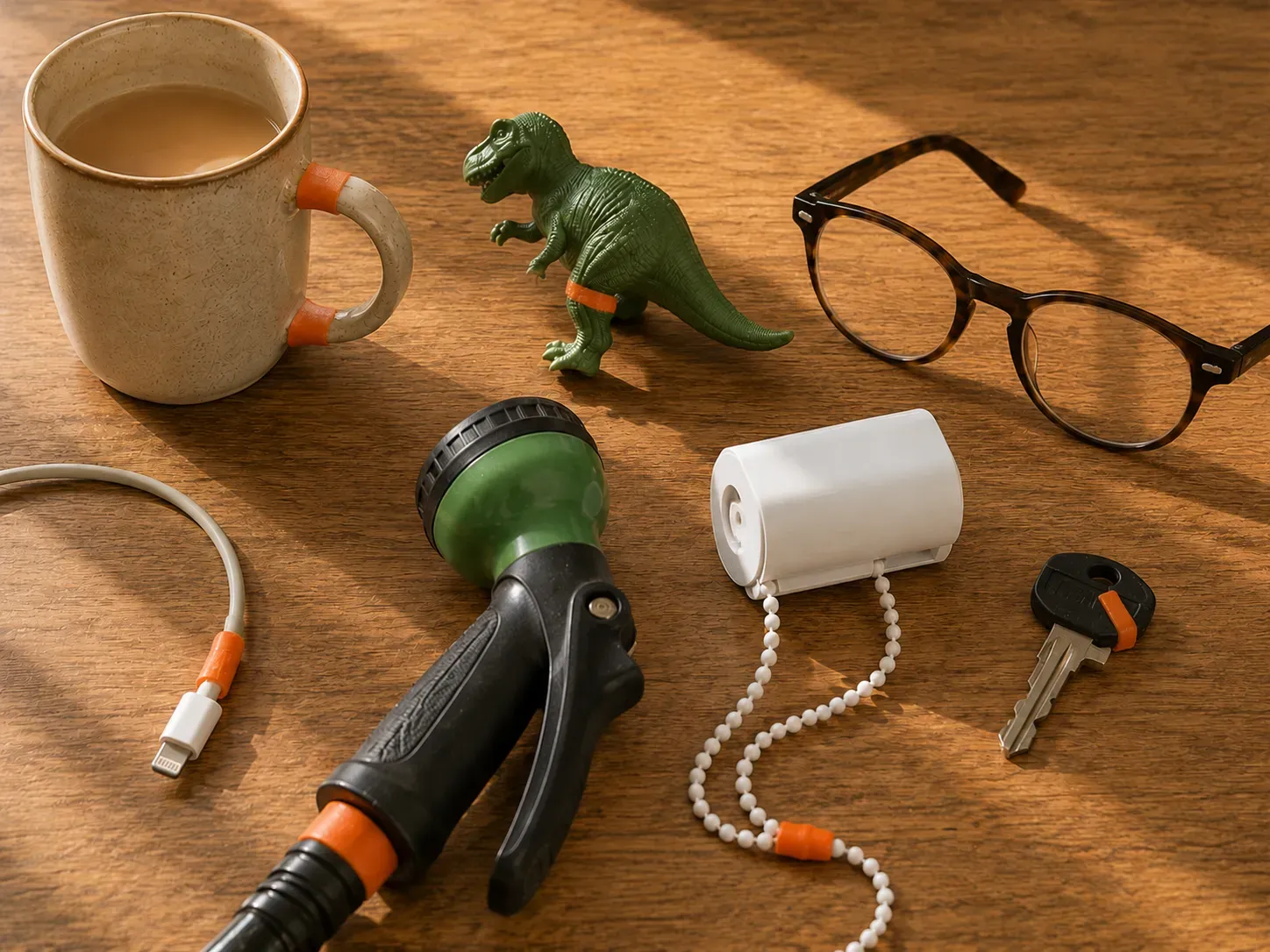
This is the part I find most compelling when I look back on it. Not any single repair — the cumulative picture of what one $20 pack made possible.
Week 1
- Frayed MacBook charger cable at the connector (my son’s — the one he’d been stepping on for months)
- Cracked plastic bracket on the car’s center console: the clip holding the cup holder lid had snapped
Week 2
- Snapped leg on a plastic toy dinosaur
- Loose screw housing on my daughter’s eyeglasses — the plastic thread had stripped and the screw wouldn’t hold
Week 3
- Broken handle on a ceramic coffee mug (a sentimental one, too nice to throw away)
- Cracked plastic housing on a garden hose nozzle
Week 4
- Stripped plastic thread on a storage bin lid — the kind that should twist-lock but had worn completely smooth
- Frayed pull cord on the roller blind in the kitchen, split through at the attachment point
Week 5
- My daughter’s phone charger: same split-connector problem, same five-minute fix
- Plastic foot broken off a kitchen appliance, making it rock and wobble on the counter
Week 6
- Cracked step on a plastic step stool
- Broken latch on a storage container
Twelve repairs in six weeks, from two of the three sticks in the pack. I still have material left. By my rough count, those items would have cost somewhere between $80 and $150 to replace outright. Most of them I genuinely would have thrown away. I would have told myself I had no choice.
FixIts vs. Superglue vs. Sugru
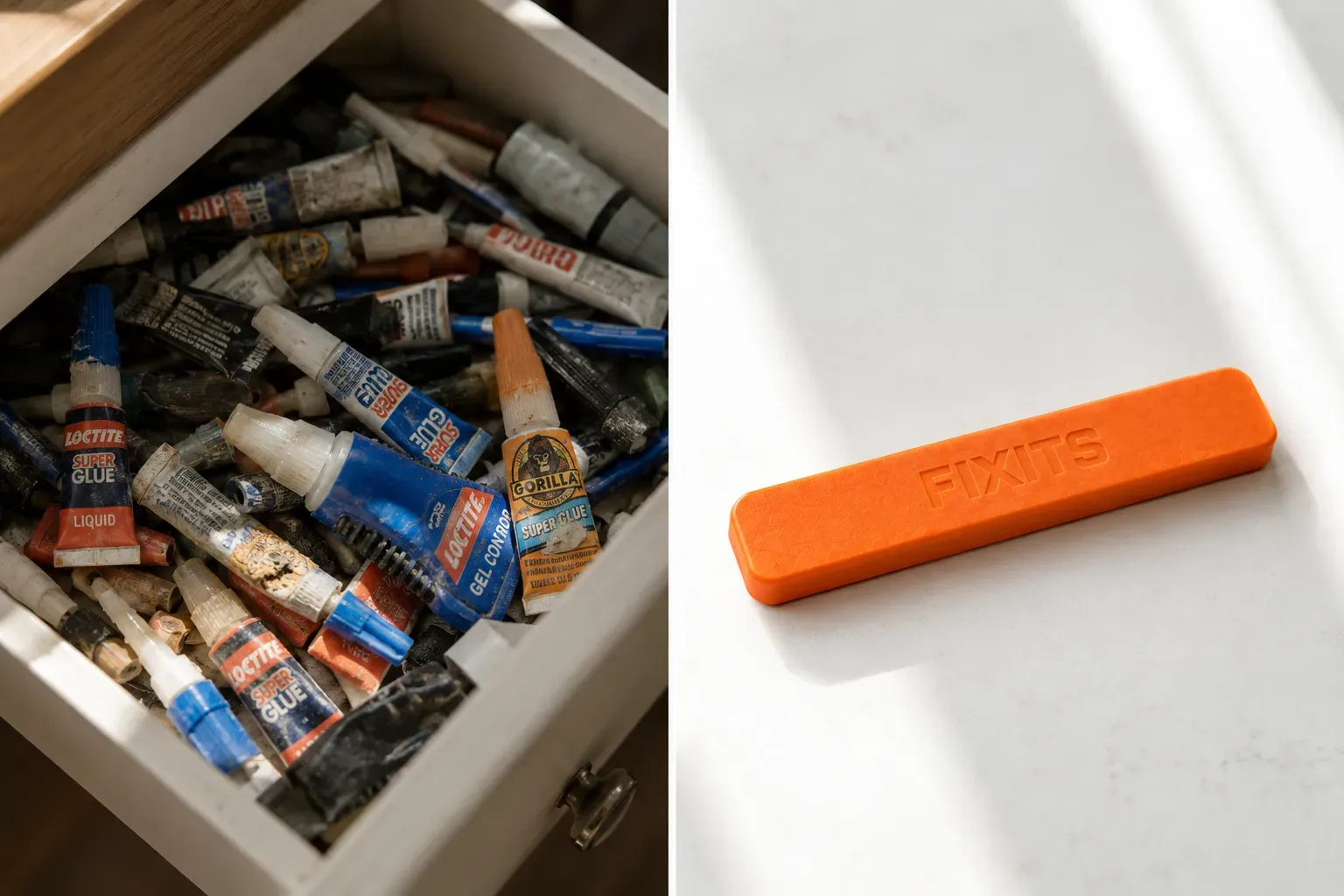
Here is the honest comparison I wish I’d had before spending years cycling through alternatives:
| FixIts | Superglue | Sugru | |
|---|---|---|---|
| Reusable | Yes — unlimited times | No — single use | No — hardens after opening |
| Reversible / Adjustable | Yes — reheat and redo | No — permanent bond | No — permanent once cured |
| Non-toxic / No fumes | Yes | No — cyanoacrylate fumes | Yes |
| Time to full strength | 2–3 minutes | Instant bond, 24hr full cure | 24 hours |
| Shelf life | Indefinite | Dries out within months | 6–12 months |
| Works on flexible materials | Yes | No — becomes brittle | Yes |
| Cost per repair | Pennies | Low — but wastes most of the tube | $2–4 per pack |
What Real Customers Are Saying
“Three sticks for $20 saved me over $150 in replacements. I fixed the storage bracket in my car, a whiteboard, multiple toys — and I still have material left over. This is the kind of product you buy once and wonder why you waited so long to find it.”
— Susan R., mother of three ✅ Verified Purchase
“I was genuinely skeptical — it sounded too simple. Then my husband stepped on my MacBook charger and I figured I had nothing to lose. The repair took four minutes and honestly feels stronger than the original cable housing. I’m completely converted.”
— Helen K., school administrator ✅ Verified Purchase
“Fixed my phone charging cable and then the pull cord on the roller blind in my kitchen. Two repairs I’d been putting off for months because I didn’t know what to use. Done in under twenty minutes total. Already ordered a second pack.”
— Hazel M., stay-at-home mom ✅ Verified Purchase
“Used it to re-thread a stripped plastic screw housing — something I didn’t think was even fixable. It molded right into the gap, hardened completely, and holds a screw just fine now. Far exceeded what I expected from a $20 product.”
— Nick P., DIY enthusiast ✅ Verified Purchase
Who FixIts Is Right For — And Who It Might Not Help
FixIts is likely a good fit if you:
- ✅ Have kids or pets at home and need a non-toxic, fume-free repair option
- ✅ Are tired of throwing away items that are broken in small, fixable ways
- ✅ Want something reusable that doesn’t expire, dry out, or get wasted after one use
- ✅ Deal with cable repairs, plastic fractures, loose joints, stripped threads, or broken handles
- ✅ Have ever made a glue mistake you couldn’t undo and desperately wanted a second chance
FixIts may not be the right solution if you:
- ⚠️ Need a completely invisible repair — FixIts leaves visible orange material (it’s paintable, but still present on the surface)
- ⚠️ Are repairing surfaces that regularly exceed ~60°C / 140°F — sustained heat will re-soften the material
- ⚠️ Need to bond two flat surfaces flush together — it works best wrapping around joints and filling gaps, not bonding smooth flat faces edge-to-edge
- ⚠️ Are dealing with structural or load-bearing repairs — for anything safety-critical, consult a professional
Final Thoughts
I want to be honest about what changed for me — because it wasn’t just the repairs.
It was the mindset shift that came with knowing I could fix things. For years I’d been running a quiet calculation in my head every time something broke: Is it even worth trying? What if I make it worse? Is this just going to end with glue on my fingers and the thing in the trash anyway? FixIts removed that mental overhead entirely. The answer is almost always: try it — and if it doesn’t work out, heat it back up and try differently.
That’s not a small thing. That’s the kind of tool that changes how you move through your house.
Six weeks in, there are twelve things on my shelves that should have been in a landfill. My kids still have their toys. I still have my coffee mug. The chargers work. And I have not once reached for superglue.
The 30-day money-back guarantee means the risk of trying it is essentially zero. That’s the argument that convinced me, and it’s the one I’ll pass on.
Up to 50% Off — Limited Time
30-day money-back guarantee · No fumes · Reusable forever · As seen on Dragons’ Den
Get My FixIts 3-Pack →If it doesn’t work for you, you get every dollar back. No questions asked.
This article contains affiliate links. If you purchase through these links, we may earn a small commission at no extra cost to you. All opinions expressed are my own and based on personal experience. Individual results may vary. FixIts is not intended for structural, load-bearing, or safety-critical repairs. Do not use on surfaces that regularly exceed 60°C / 140°F.